The Summit for Democracy seems to have done more harm than good, notes Ambassador T P Sreenivasan.

'We have been bold and innovative on recognition in the past and we do not need to rush,' advises Ambassador T P Sreenivasan.
'No prime minister of India is averse to normalise relations with Pakistan, if it is possible to do so without altering our fundamental position on Jammu and Kashmir,' notes Ambassador T P Sreenivasan.
'India appears to have stood its ground on strategic autonomy by resisting US pressure on Russia, China and Iran, but succumbed to the temptation to walk into a tighter embrace in defence cooperation, a high priority of the Trump administration,' notes Ambassador T P Sreenivasan.

The trust some people in India had that the Biden-Harris administration would be friendly to India has been eroded already, observes Ambassador T P Sreenivasan.
'The challenge before the two countries is to turn the peak into a plateau and enter an irreversible phase of cooperation,' notes Ambassador T P Sreenivasan.
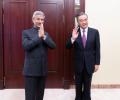
The effort made to define the larger picture by focussing on history and the wish not turn differences into disputes and conflicts is welcome. In the obtaining circumstances today, nothing more could have been possible, observes Ambassador T P Sreenivasan.

'Instead of fighting over whatever will be left of the present world, the permanent members of the UN security council should have raised a little finger to arrest the death and devastation around us,' notes Ambassador T P Sreenivasan.
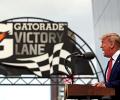
'Another rejection of mediation between India and Pakistan will leave Mr Trump disappointed.' 'In that case, he is likely to point out the war-like situation on the border and press for direct talks which have been stalled on account of continuing terrorism from Pakistan,' notes Ambassador T P Sreenivasan.

'The success or otherwise of Modi's foreign policy will largely depend on the equation he is likely to strike with Donald Trump.'
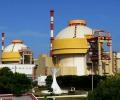
'Decisions on nuclear power have so far been taken by a small select group, primarily interested in profiteering from their actions, stating 'secrecy' as necessary from the national security point.' 'This argument is false, because we are dealing with the 'civilian' nuclear power sector, which is open even to the IAEA,' says Dr A Gopalakrishnan, former chairman of the Atomic Energy Regulatory Board.
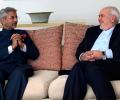
'Tehran,' Foreign Minister Zarif said, 'had expected the Modi government to be "more resilient" in the face of Washington's bullying,' notes Ambassador M K Bhadrakumar.
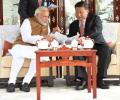
'Till today, we don't know what PM Modi discussed with Xi Jinping and Vladimir Putin, but we have been told that the relations have been reset.' 'We have no evidence from China to show that anything has changed, even though India had made several gestures in preparation for Wuhan,' says Ambassador T P Sreenivasan.

Whatever be Kamala Harris's preference for her identity, many Indians in the US will rally around her as she is the first person with Indian blood in her veins to get close to the White House, observes Ambassador T P Sreenivasan.

The Nobel Prize for Malala may have caused deep divisions across the globe and disturbed the peace, while the award to OPCW, though not without critics, may have served the cause of peace by eliminating a weapon of mass destruction from the face of the earth, says Ambassador T P Sreenivasan.
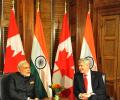
The company is excited over the pact, which it says marks the 'start of a new relationship' between the two countries.

The world is still figuring out the man as he continues his enigmatic journey towards the first 100 days of his presidency.

Obama seeks reduction of nuclear arsenal in India and Pakistan while Pakistan seeks NSG membership

The United States has lifted most of its sanctions against Iran after a UN watchdog reported that Tehran had complied with a nuclear weapons deal.
'There is nothing that Pakistan has done which deserves a resumption of dialogue. The assurances made in Ufa contain no commitment except a whole range of talks, which could take place without the paraphernalia associated with a joint statement of prime ministers.'

'Presidents may come and go, but America will go on forever,' an American business leader tells Ambassador T P Sreenivasan in New York.

'The call to isolate Pakistan on the ground of sponsoring and supporting terrorism, particularly when the UN has not even defined terrorism, is a wild goose chase.' 'The responses of the various countries to the Uri attack provides testimony to this fact.' 'No country, not even Russia, was willing to condemn Pakistan for this dastardly act,' says Ambassador T P Sreenivasan.
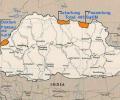
'The only choice we have is to strengthen ourselves militarily and economically and develop friendships with others without alarming our neighbours, says Ambassador T P Sreenivasan.

'Islamabad is only as big as a Delhi suburb.' 'How can a city with just two five star hotels and only one departure gate at their international airport be compared to Delhi with its sprawling airport?' Ambassador T P Sreenivasan finds the pulse of Pakistan after visiting Islamabad for the first time.

'In a relationship that does not permit cricket, how can the prime ministers embrace and send a false message,' asks Ambassador T P Sreenivasan.

To the extent the nuclear race in West Asia is slowed down by the Iran nuclear deal, the world as a whole has reason to be happy, says Virendra Kapoor.
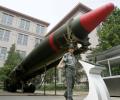
Despite four disarmament section talks and six strategic dialogues between the two foreign ministries, China's intransigence on recognising Indian nuclear status resulted in no confidence building measures in the nuclear field between the two, says Srikanth Kondapalli.
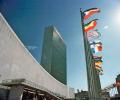
On October 24, the United Nations turns 70. 'The credibility of the UN has been eroded by the fact that the Security Council does not represent the political realities of the world today,' says Ambassador T P Sreenivasan, listing the 10 things the UN needs to do to become more relevant and effective.

The powerful United Nations Security Council on Monday unanimously adopted a resolution that endorses the landmark nuclear deal between Iran and six world powers.

The new equation between 'Namo' and 'Barack' may well 'convert a good start into lasting progress.'

The biological weapons convention is a non-starter in spite of the efforts of many states in the world for the last five decades mainly because the US is not ready to accept the 'verification protocol' which could allow the formation of some official mechanism for inspections, says Ajay Lele.

'I recall an encounter I had with a US Congressman of Cuban origin, who was hostile to India because of our continuing goodwill for Cuba.' 'He asked me why India was still friendly with Cuba and I gave him an honest answer that it was rooted in historical and friendly ties.' 'He took it as an affront and spread the word that an Indian diplomat had defended Fidel Castro in his chamber!'

Obama's decision to visit India must be a result of his judgement that Modi is a man of action, feels Ambassador T P Sreenivasan.

'To expect that he has a magic wand to resolve all differences and announce breakthroughs in all issues during his first visit to the US is to be unrealistic,' says Ambassador T P Sreenivasan.

'If ever India loses its patience after repeated terror attacks and decides to retaliate against the terrorist camps, Pakistan may term that a conventional military attack and invoke the nuclear option. This is a way to continue with terrorism without retaliation.'
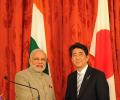
'Secretiveness and the element of surprise in announcing decisions marks the Modi style of diplomacy. From being a voluble politician, he became a reticent statesman... But the diplomatic dance is performed on thin ice and his adroitness is still to be proved,' says Ambassador T P Sreenivasan.

'Modi's promise of change during the election campaign was on the domestic front, but his first year in office focused on foreign policy beyond all expectations,' says Ambassador T P Sreenivasan.
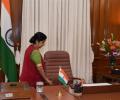
Sushma Swaraj, like Clinton, has a strong political base in her own party and is likely to have her imprint on foreign policy, says Ambassador T P Sreenivasan.
